Author: Felipe Bahiense

  • Sustainable hyperautomation: energy efficiency and responsible AI

    Sustainable hyperautomation: energy efficiency and responsible AI

    Sustainable hyperautomation is the link that unites innovation, productivity, and ESG commitment in a single long-term strategic movement.

    Hyperautomation is no longer just a trend, it has become a reality in large enterprises. Platforms that combine RPA, Artificial Intelligence, systems integration, and governance promise significant productivity gains, transforming the way organizations operate. 

    However, a critical point that is often overlooked is sustainability: it is not enough to automate everything. If poorly planned, the race for efficiency can generate excessive energy consumption, resource waste, and ethical risks.

    Gartner reports indicate that 90% of large organizations already treat hyperautomation as a priority. However, fewer than 20% have solid metrics to assess their impacts and efficiency. This means most organizations automate without properly measuring IT energy efficiency and the environmental or social cost, a mistake that can jeopardize ESG initiatives and even lead to regulatory sanctions.

    In this context, sustainable hyperautomation emerges as the convergence between technological innovation and socio-environmental responsibility.

    What is sustainable hyperautomation?

    Sustainable hyperautomation consists of adopting advanced automation solutions with a strategic outlook on resource consumption, environmental impact, and the ethical governance of AI. 

    Rather than simply automating for automation’s sake, companies seek to optimize energy use, reduce carbon emissions, manage data responsibly, and ensure that the algorithms used are transparent and free of bias.

    This concept rests on three pillars:

    1. Energy efficiency: ensuring that automated processes are energy-optimized, from data center infrastructure to the choice of more efficient algorithms;
    2. Responsible AI: developing and applying AI models with ethical criteria, transparency, explainability, and mitigation of bias and distortions;
    3. Sustainable lifecycle: considering the entire lifecycle, from choosing technology suppliers to disposing of and upgrading equipment, avoiding waste and prioritizing renewable energy sources.

    What are the risks of not investing in sustainable hyperautomation?

    Although the clear gains offered by hyperautomation are well known, poor implementation or inadequate oversight brings risks such as:

    • Energy overload and hidden costs: large AI models and bots operating 24/7 significantly increase energy consumption and cloud costs. Without an optimized architecture, automation can cancel out the very efficiency gains it was meant to deliver;
    • Redundancy and automated chaos: automating processes that are inefficient or poorly mapped only accelerates failures. The result is computational waste, duplicated tasks, and server overload, generating hidden costs and unnecessary environmental impacts;
    • ESG governance and compliance: regulators and investors demand proof of positive impact. A lack of IT sustainability metrics, traceability, and carbon reports can lead to fines and damage corporate reputation;
    • Ethical and AI bias risks: automated decisions made without human oversight can amplify deviations, violate the privacy of customers or partners, and undermine brand trust. For this reason, hyperautomation must be planned with integrated responsibility, ethics, and governance.

    Energy efficiency and responsible AI: pillars of sustainable hyperautomation

    Data centers and AI systems already consume around 1.5% of the world’s total electricity, and studies project an increase of more than 160% by 2030.

    In this scenario, companies pursuing hyperautomation need to ensure their IT environments are energy efficient, adopting cloud providers powered by renewable energy, compact algorithms, and continuous consumption monitoring to avoid waste and hidden costs.

    But efficiency alone is not enough. Automating critical processes requires responsible AI, with explainable models, free of bias, and compliant with regulations such as LGPD. 

    This makes it essential to document the algorithms’ lifecycle, protect data with advanced privacy techniques, and maintain AI governance. Ethics committees and contingency plans should also be created.

    Integrating energy efficiency and AI responsibility turns hyperautomation into an engine of sustainable productivity. This approach strengthens the company’s reputation and ensures that technological gains do not come at the expense of the planet or customer trust. 

    Why do intelligent processes outperform the practice of automating everything?

    Numerous studies have shown that processes orchestrated with responsible AI can predict energy peaks, reduce failures, and optimize consumption. However, human oversight and retrospection are essential to prevent automated decisions from undermining sustainability.

    Companies that simply robotize tasks without reviewing workflows and eliminating waste run the risk of accelerating inefficiencies. This can raise costs and increase environmental impacts.

    The real gain lies in creating intelligent processes, where automation eliminates redundant steps, reduces errors, and operates with minimal energy consumption.

    Principles for intelligent and sustainable hyperautomation

    Companies that want to reap real benefits need to go beyond simply implementing bots. Best practices in sustainable hyperautomation include:

    1. Automate with purpose, not as a trend: use data to analyze activity flow, uncovering inefficiencies and bottlenecks. Always prioritize automations that have a direct impact on reducing costs, failures, and energy consumption;
    2. Efficient and scalable architecture: adopt cloud infrastructures with renewable energy policies and automatic scaling. Favor compact, optimized AI models, avoiding unnecessary CPU and GPU loads;
    3. Continuous measurement of consumption and emissions: monitor the energy expenditure of each automated flow in real time. Establish efficiency KPIs, such as kilowatt-hours per process, to link ROI to sustainability;
    4. Responsible AI with human oversight: include human intervention in the lifecycle of automated systems, especially for critical decisions. Ensure explainability, auditing, and periodic review of models to reduce bias.
    5. Integrated governance and ESG policies: create multidisciplinary committees to evaluate new projects. Align hyperautomation goals with carbon neutrality objectives and ESG reports.
    6. Continuous improvement cycle: after deployment, review and refine. Reduce unnecessary steps, reassess algorithms, and adjust scaling. Use monitoring data to disable or simplify automations that fail to deliver value.

    Fusion Platform as the backbone of hyperautomation

    For hyperautomation to reach its full strategic potential, it is essential to have a complete ecosystem of automation tools that makes it possible to standardize, monitor, and control processes.

    The Fusion Platform is an integrated solution that centralizes data, processes, indicators, and all corporate management. As an integrating platform, it not only manages and automates processes but also connects sustainable RPA, AI, forms, and governance, offering a unified and efficient view of operations.

    Without a doubt, it is a fundamental resource for ensuring visibility and governance for energy efficiency and responsible AI initiatives. 

    Key Fusion Platform modules

    With specific modules, Fusion Platform enables intelligent automation and innovation with features such as: 

    • Process management (BPM): maps end-to-end workflows, identifies bottlenecks, and ensures that automation delivers real value;
    • Indicator management (KPIs): performance dashboards monitor energy consumption, emissions, and efficiency in real time;
    • Risk and compliance management: anticipates AI vulnerabilities,  protects sensitive data, and ensures regulatory compliance;
    • Document management (ECM): digitization, classification, and control of critical information, reduced paper use, faster approvals, and traceability. 

    Since automating business processes without planning is a risky shortcut, by incorporating Fusion Platform into your business, your company builds a solid foundation for monitoring the lifecycle of operations, from conception to review, expanding the positive impact on sustainability.

    In other words, it’s the starting point for sustainable hyperautomation, allowing it to happen with purpose and awareness.

    This approach is not just a competitive advantage: it is a market and regulatory requirement. Companies that automate intelligently, measure impacts, integrate governance, and prioritize responsible AI reduce costs, minimize risks, and strengthen their ESG image.

    True sustainable hyperautomation means putting technology at the service of business and the planet. That is the secret to uniting innovation, ethics, and environmental responsibility. Why not start today? Try Fusion Platform and put your business on the path to a sustainable, innovative, and efficient future.

  • The role of Governance in the Application of Artificial Inteligence

    The role of Governance in the Application of Artificial Inteligence

    Imagine a company that decides to implement Artificial Intelligence to accelerate its processes, analyze large volumes of data, and make decisions more efficiently.

    However, questions soon arise: Who has access to the data? Who validates AI-driven decisions? Are the models up to date? Are the results reliable?

    In this context, process and data governance plays an essential role. Regardless of company size whether a growing small business or an established corporation implementing AI without a solid governance foundation is like building a skyscraper on sand.

    On the other hand, with well-structured governance through Fusion Platform, AI becomes strategic, secure, and scalable, generating real value aligned with business objectives.

    Therefore, if your organization aims to grow through AI without compromising control, efficiency, or security, this content is for you.

    Process Governance is not just for large enterprises

    The adoption of Artificial Intelligence-based solutions has grown exponentially in organizations of all sizes. As a result, new opportunities emerge, but so do new challenges.

    However, many organizations still view governance as a secondary concern or something exclusive to large corporations.

    In reality, process governance is the system that defines rules, roles, responsibilities, and decision-making criteria to ensure that organizational processes are managed effectively, securely, and in alignment with business strategy.

    What does Governance look like when applied to AI?

    In the context of AI, governance is the framework that ensures technology serves the organization’s objectives not the other way around. After all, offering an intelligent chatbot is of little value if the underlying data is not properly organized.

    In this sense, governance involves:

    • Clear roles and responsibilities: knowing who performs each step of the process and understanding their responsibilities;
    • Alignment with organizational strategy: integration with business objectives and the ability to adapt to changes and optimization initiatives;
    • Standardization and documentation: mapping and automated execution to connect processes, documents, and departments;
    • Performance indicators: measurement based on consolidated and structured process data;
    • Change management: a solid information foundation that supports continuous improvement with a holistic perspective.

    In summary, companies that treat AI as an isolated project, without integrating it into their data and process management strategies, end up wasting resources and increasing risks.

    Complete Governance with Fusion Platform

    Corporate governance only becomes a reality when it is applied in daily operations through well-defined processes, organized documents, and reliable performance indicators.

    To achieve this, organizations need a solution that provides intelligent integration between documents, workflows, and performance data. Without this integration, efforts become fragmented, and the company loses visibility and control.

    Governance and IT: the link that turns strategy into results

    For governance to be effective, it must be supported by a robust technological infrastructure that is integrated and responsive to business needs. This is precisely where the IT department evolves from a support function into a strategic driver.

    By adopting a comprehensive platform such as Fusion Platform, rules, workflows, documents, and decisions can be executed, monitored, and continuously improved in a secure and scalable manner.

    Start structuring today what will sustain your AI tomorrow

    As we have seen throughout this article, governance plays a central role in the efficiency and scalability of organizational processes. More than simply mapping or automating tasks, it is essential to rely on a robust solution that integrates processes, indicators, documents, and overall management in a clear and standardized way.

    Want to learn more about how to transform AI into a competitive advantage? Download the full eBook today:

  • AI in Fusion Platform’s: See all the news

    AI in Fusion Platform’s: See all the news

    Much is said about the benefits of good implementation of Artificial Intelligence in organizations. In fact, AI in Fusion Platform acts as a powerful ally in the automation and optimization of process management.

    A study published by IBM Global AI reported that 44% of companies that use AI in some function have already seen direct improvements in efficiency and performance in repetitive tasks.

    In Brazil, this number tends to grow as technologies such as the Fusion Platform facilitate practical integration with corporate processes.

    However, despite the enthusiasm, many companies still face major challenges in incorporating AI into their operations.

    The practical application in an integrated way to the processes is still limited. There is a lack of maturity, clarity about the objectives, and often enough data in sufficient quantity and quality to enable the use of AI safely and efficiently.

    The explanation is quite simple, the solution only generates real value when fed by reliable, organized, available and properly contextualized data within the logic of each process.

    As it is an all-in-one solution, check out the new AI features in Fusion Platform and understand how adopting this solution is affordable, practical, and aligns with your company’s needs.

    How are process management and AI in Fusion Platform’s related?

    The difficulty in making AI effective in practical applications within companies comes from some scenarios, such as:

    • AI projects that have not left the pilot phase;
    • Dispersed, low-quality, and hard-to-access data;
    • Difficulty in delivering real gain.

    Unfortunately, Artificial Intelligence seems like a big “fad” that every business wants to get into. However, without proper preparation, or including AI at any cost, without process automation and structured data, there is no real value delivery.

    Want an example?

    Imagine that a retail company uses AI to automate the approval of purchase orders and inventory. The technology analyzes sales history, identifies consumption patterns, and automatically generates orders to avoid stockouts and improve turnover.

    However, the sales process is not well mapped and cancellation, returns, or promotions information is not integrated.

    The consequence of this you can already imagine. AI makes decisions based on mistaken information and in a short time wrong products are purchased in large quantities, there is compromised cash flow, dissatisfied customers, and so on.

    Of course, as it is a technology, AI did not make a mistake, per se. What happened is that the process was poorly structured and the data is inaccurate. Not even the most advanced model will work if it is fed by bad data.

    In summary, process management is essential as a strategic foundation to reap expressive results from Artificial Intelligence.

    So, what do I need to do for my business to succeed using AI?

    When we talk about AI in Fusion Platform, the first step is to structure the processes: it’s the famous “well-done basics that work”. In other words, it is necessary to organize, integrate, and structure the data, and then use technological resources.

    This is one of the great advantages of AI in Fusion. Because it is focused on the management of processes, documents, and data, there is context and clean data providing technology to add value to the business.

    Thus, after structuring the processes, it is necessary to identify where AI can be best used, such as in the automation of repetitive tasks or data analysis, for example.

    With technologies such as intelligent OCR, automatic data extraction and classification, applied AI brings real results, such as:

    • Elimination of bottlenecks in the processes;
    • Greater agility and productivity;
    • Documents always available;
    • Mobile signature to sign documents from wherever you are;
    • Reduction of manual errors;
    • Greater visibility and control;
    • Efficient governance

    It’s not enough to adopt technology, you need to integrate it into the right processes, train your team, and ensure that the data used is reliable and well-organized. By doing so, AI is no longer just a promise and becomes a real engine of productivity, innovation, and competitive advantage.

    The main features of AI in Fusion Platform

    With more than 500 thousand users worldwide, in different fields of activity, Neomind offers a series of new features to assist its customers in the management of processes, documents and indicators

    AI in the Fusion Platform is one of the great differentials and novelties brought, with emphasis on Nia, Neomind’s AI assistant. It is important to note that the solution was developed based on ethical standards, respecting LGPD and international data protection guidelines. All processed data is encrypted and kept under strict access control.

    How about checking out all the news?

    Model processes with the help of chatbot

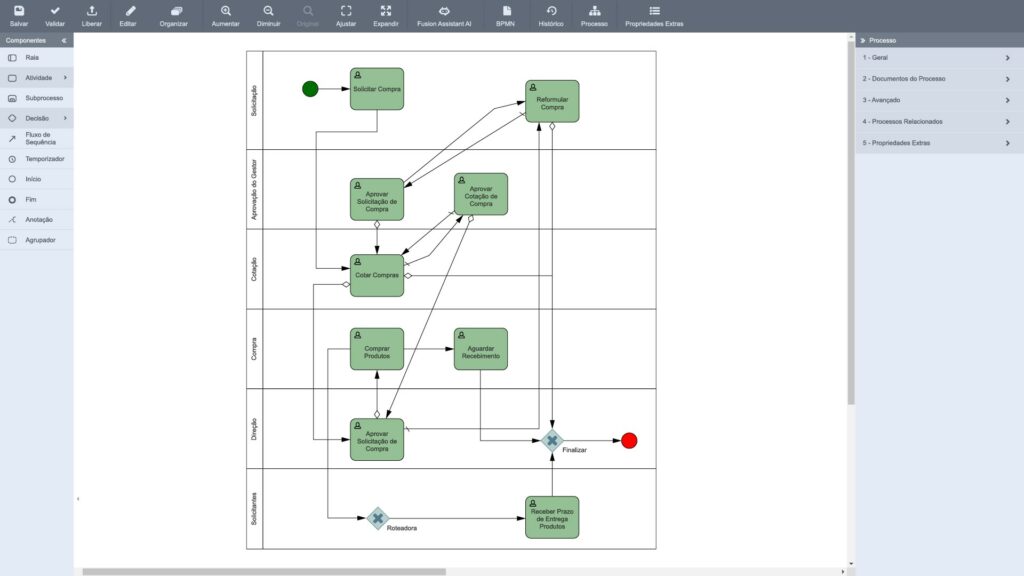
    In the chat with Nia you can ask her to model a business process. To do this, all you have to do is direct Nia with simple but detailed instructions.

    In a matter of a few seconds, Fusion’s AI will present a properly constructed flow of activities, with related activities, decisions, approvals, among others.

    The platform also learns from operational flows to suggest improvements, anticipate bottlenecks, and identify patterns of behavior. This allows processes to evolve continuously, reducing rework, optimizing time, and increasing productivity.

    Autofill forms

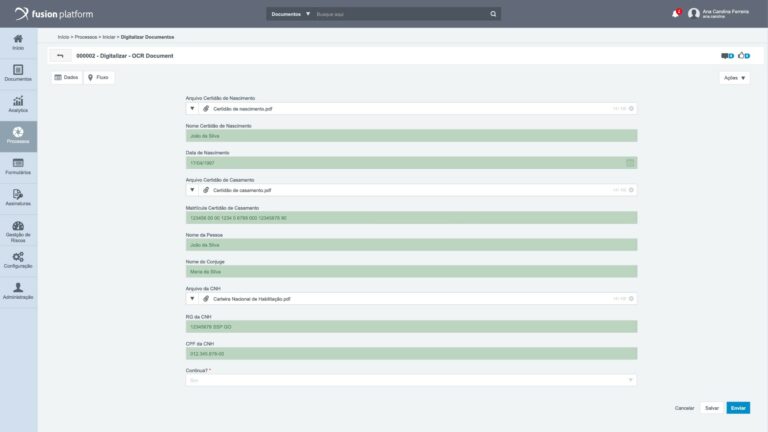
    Fusion’s AI is capable of collecting, interpreting, and structuring data from a variety of sources, such as documents, images, systems, and interfaces. It is a feature widely used to automate repetitive tasks, ensuring accuracy and agility.

    Basically, the Fusion Platform user only needs to upload the file. In seconds, the AI will extract the data and fill in the form fields automatically, reducing the error rate.

    Want an example? Think about the admission process, the HR analyst does not need to manually fill in the CPF numbers or work card. All you need to do is add the documents directly to the platform. In a few seconds, Fusion’s AI extracts the information and fills in the form fields, without any human intervention. That’s right, your employee doesn’t need to type anything manually.

    The tool can also interpret contracts, invoices, work orders, and reports, extracting the relevant data to feed the company’s systems and trigger processes automatically.

    Information extraction

    Do you have a large process or do you need to extract information quickly and practically? In the chat with Fusion’s AI, just ask what you need, and it will answer.

    This functionality is excellent for team and process management, as it makes control and decision-making more practical and simplified.

    For example, you are the manager of a large team and you need information about a specific process, instead of accessing a dashboard, just ask: Nia, who are the top 10 requesters of the procurement process?

    Precise answers about the documents?

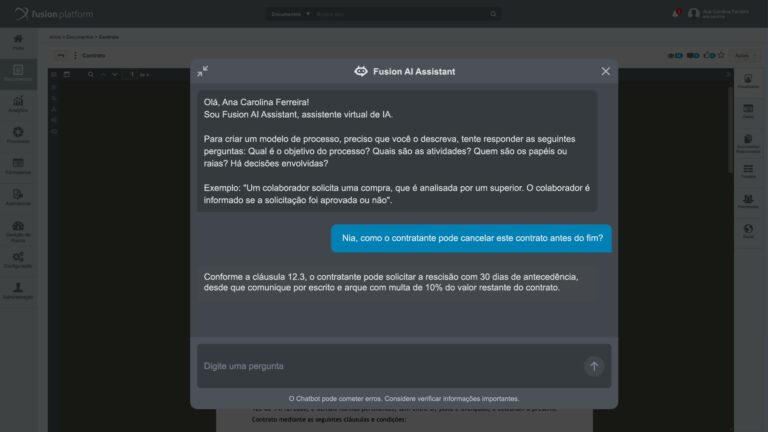
    Nia acts as a digital co-pilot for users, answering questions and suggesting insights. You can extract information quickly, even if it’s a complex document, or a very long one.

    Instead of flipping through countless pages looking for a single piece of information, just open the chat and ask: Nia, how can the contractor cancel this contract before the end?

    Document translation with the help of Fusion AI

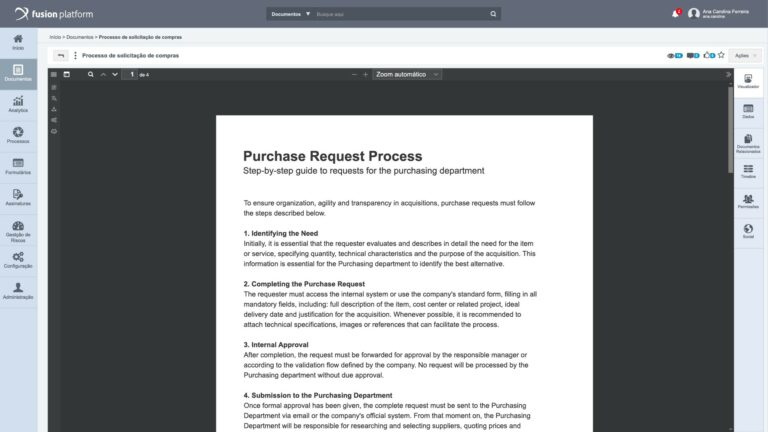
    Another feature of Fusion Platform’s AI is the instant translation of documents. In seconds you can convert documents to several languages, without complications.

    The practicality is ideal for companies that work with multilingual environments, are multinationals or work with international documents on a daily basis.

    In addition, you get accurate answers from your documents, in the language you need. To do this, choose the language you want the translation and wait, in a few seconds a translated version of the document will be presented and automatically saved on the platform.

    Artificial intelligence in Fusion Platform isn’t just a technological innovation. It is a strategic ally for companies that want efficiency, control, and concrete results.

    Do you want to see in practice how AI can transform your processes?

    Try the new features of Fusion Platform now and discover how AI can eliminate bottlenecks, accelerate flows, and transform your management.

  • How BPM promotes innovation in companies

    How BPM promotes innovation in companies

    With an ever-changing changing environment, new challenges and opportunities arise every day. In order to overcome each obstacle and take advantage of opportunities, high-performing organizations have already realized that one of the ways to remain competitive is by keeping their focus on innovation.

    But not a random innovation. Here, as we are talking about successful companies, we refer to a well-managed and structured innovation. An example cited on the DBizinstitute website explains better what we are getting at: Amazon took down physical bookstores in the United States. The company didn’t invent the book, what it did was create a new sales process. In other words: it innovated the way of selling.

    We can continue with the example of Amazon. In the next step of innovation, they became an online retailer. Today, its retail platform is offered to other businesses that want to sell their products online.

    And how does a company (not just Amazon) manage to move forward with innovation? Here, there is no mystery: it is necessary to start a process whose final result is innovation. Therefore, in this article we draw your attention to an important duo: innovations and BPM (Business Process Management).

    To start: the term innovation

    “Innovation” is practically the golden word in the business world. As Wikipedia explains, types of innovation include:

    • Product innovation: the introduction to the market of new or significantly improved products or services. It includes changes to its technical specifications, components, materials, software, interface or other functional characteristics;
    • Process innovation: implementation of new or significantly improved production or logistics processes for goods or services. It includes changes to techniques, equipment, or software;
    • Organizational innovation: implementation of new organizational methods in business practice, work organization and/or external relations;
    • Marketing innovation: implementation of new marketing methods, involving significant improvements in product or packaging design, pricing, distribution and promotion.

    Innovative ideas are not difficult to come up in a brainstorming session, for example. The difficult thing is to make innovation take shape. That’s where process management comes in.

    How does BPM promote innovation within companies?

    To answer the question, it is initially necessary to understand what we gain when we adopt Process Management. First and foremost, BPM is organized around outcomes, not tasks. This may not catch your attention at first, but when activities are organized around tasks, focus is lost. When you know where you want to go (that is, you know the expected results) everyone involved walks in the same direction.

    When we talk about innovations and BPM, it is important to think of innovation as a process, which must be defined, implemented, executed, and controlled. A BPM tool, in addition to managing the entire life cycle (stages) of processes, allows them to be standardized. With this, not only does it make it easier to understand and manage them, but the probability of errors and risks is reduced.

    Another point that we highlight when dealing with innovations and BPM is that the latter is essential for the implementation of Continuous Process Improvement methodologies, such as Lean and Six Sigma. As we explain in this article:

    • The Lean methodology simplifies (streamlines) a process flow until waste and non-value-added activities are eliminated.
    • Six Sigma is a quality tool that currently plays a very important role so that products or services can be delivered without errors or failures.

    Remember that I mentioned that Business Process Management organizes activities around results? Well, to systematically move forward with an innovation you need to carry out a process whose final delivery is the innovation as a result. BPM solutions take this approach, and are also used to implement the process and controls around the areas that are getting in the way of a goal being met.

    BPM can act as a catalyst to accelerate the application of Lean and Six Sigma methodologies and can increase organizational efficiency and profitability by enhancing business processes with three important elements – agility, visibility, and efficiency (three essential elements for innovation to be put into practice).

    Innovations and BPM: the duo

    We understand that process is defined as a series of actions that aim at a result (produce something) and transform inputs into outputs. Innovation can also be defined as the application of better solutions that meet new requirements or needs. We also mention four types of innovations: product, process, marketing and organizational innovation.

    Note that each of the types mentioned is about the introduction or improvement of something (for example: in process innovation we have the implementation of new or significantly improved production or logistics processes for goods or services).

    For the innovation process to bring the desired results and in the expected time – whether to introduce something or to make some improvement – it is essential that it follows a workflow with defined responsibilities and deadlines. It is also important to highlight that with more fluid workflows, the company’s innovation processes become agile, reducing the response time to the market.

    In addition, from the moment that the team involved in innovation has a better understanding of how processes should be conducted, the entire company becomes more efficient in the face of market challenges. This understanding, as well as the increased transparency and productivity provided by work flows, are possible thanks to a Business Process Management solution. Exactly why innovations and BPM must go hand in hand.

    What’s the proposal of this article?

    Our proposal for this article was to show you that in an extremely competitive market we must innovate in a structured way. Thus, errors and risks are reduced, and a more improved control of the progress of activities is maintained.

    When we understand the relationship between innovations and BPM, we start to adopt a much more serious and structured approach to our activities. If you want to better understand the universe of Business Process Management, check out some materials that can help:

    Meet the Fusion Platform! Our solution has the BPM module, which allows you to create and manage processes in a simple way and with a high level of integration with management systems. Try our solution right now and find out how Process Management can help your company.

  • Lessons from Facebook for Document Management and Information Security

    Lessons from Facebook for Document Management and Information Security

    The founder of Facebook is on the agenda of the main newspapers around the world. Just a few days ago, Mark Zuckerberg broke his silence on a scheme of illicit use of personal data of 50 million users by the company Cambridge Analytica. According to what was released by the press, the information was used by the company to influence important decisions, such as the referendum on the separation of the United Kingdom from the European Union and the US elections.

    In Brazilian lands, we are following the unfolding of this story, and together with our interest in knowing the outcome of the Facebook and Cambridge Analytica case, we can already highlight some lessons, especially about threats to information security.

    As we have already commented on other occasions on our blog information is today one of the most important assets of corporations. We talked about paperless organizations and the importance of having a paperless environment for reasons of productivity, security and, of course, cost reduction.

    Digital Transformation contributes to the adoption of a paperless environment, however, it is important to mention that risk eradication does not happen simply because a company migrates to the paperless format. In reality, digital documents present many risks when they are not managed correctly. This is where we converge Document Management with Risk Management.

    Document Management and Risk Management

    To begin with, we live with risks in all spheres of our lives. In the corporate environment, managing risks has to do with analyzing the company’s risks to maximize opportunities and/or minimize negative impacts.

    Document Management deals with controlling the flow – storage, organization, retrieval, distribution, disposal) – of electronic documents in a secure and efficient manner to ensure that they are accessible to authorized people (as and when needed).

    Putting the two topics together, the question arises: how much does it cost to lose or leak a document? What is the risk involved in having sensitive information fall into the wrong hands? The answer to the questions you certainly already know, because just think about what your competitors could do if they knew beforehand about your new product, to name an example.

    Therefore, when we talk about information management, we have to remember how important it is for the company to optimize and automate Document Management with EDM/ECM (Electronic Document Management) software. To understand better:

    How does EDM/ECM contribute to information security?

    For your company’s information to be secure, you need to pay attention to some points:

    • An Eletronic Document Management solution allows version control: each team member authorized to view a document should be able to see the most up-to-date version, but also all revision versions. Imagine a company’s legal department: professionals in the area must be able to see the versions of the revisions to be able to understand what has been changed and if it makes sense.
    • An EDM/ECM solution has access control and security: access permissions are assigned to each document, and access can be granted to a group or a user.
    • A GED/ECM solution has a digital signature: electronic documents can be signed with certificates in the ICP-Brasil standard.

    Concluding

    As information is the most valuable asset of companies, data and documents generated by organizations must be very well managed internally. Therefore, Document Management (especially the way information is stored and accessible) is essential for any organization that cares about the security of its data. After all, we are sure that no business wants to experience the chaos of finding out that its most sensitive information has been leaked and having to put itself in Zuckerberg’s shoes to explain why. Isn’t it?

    In addition to the module for Document Management (ECM), to the module for Document Management (ECM), in the Fusion Platform we have an accelerator (ready-made process adopted) focused on Information Security Risk Management. In it, it is possible to map and record each situation of risk to the organization’s information security, as well as define actions, probabilities, and impacts. It also allows frequent monitoring of risks, their actions and the results obtained. Try our solution now or request a demo to learn more!

  • IT Governance: A Complete Guide for Businesses

    IT Governance: A Complete Guide for Businesses

    Undoubtedly, technology is a fundamental element for the success of any company. It was precisely because of this relevance that IT Governance emerged.

    Managing and aligning infrastructure and technological inputs with strategic objectives is quite complex. But by adopting a set of appropriate practices, processes, and structures, companies ensure a successful future.

    With IT governance, companies can control the business and measure the results of their decisions and investments. In addition, it maintains strategic alignment, increasing competitiveness.

    Its application is comprehensive, and brings with it benefits such as process improvement and automation, cybersecurity, cost and risk reduction, among others.

    Because it is so significant, we have prepared this complete guide with all the necessary knowledge about IT governance.

    Whai is IT Governance?

    IT Governance is a set of best practices and procedures that use recommended frameworks to ensure that the technology sector is aligned with the organization’s strategic objectives.

    To do this, it covers all the resources used, such as hardware, software, and professionals. In this sense, IT governance is indispensable for the management, control, and quality of processes, products, and services.

    This action involves:

    • Strategic alignment: correlates IT strategies and business strategies;
    • Value delivery: Proper use of technology investments – delivering maximum value with an acceptable share of risk. It is necessary to be clear about where the money will be invested, and what the expected return is;
    • Risk management and assessment: Identifies, assess, and communicates risks to the entire enterprise.  It is essential to ensure business continuity, especially compliance with legal requirements;
    • Definition and management of technology resources, including people and infrastructure;
    • Information security and compliance: protection of data and systems against improper or unauthorized access. Compliance with current laws, regulations and standards;
    • Performance measurement and continuous improvement: all practices must be constantly analyzed, reviewed, and improved;
    • IT governance culture: valuing the importance of information technology, involving managers and shareholders in management.

    The importance of IT Governance

    Technology is a powerful tool that helps companies achieve their goals, being efficient and effective in the short, medium and long term.

    With a focus on improving IT management, governance increases the company’s value and recognition, bringing benefits such as:

    • greater information security;
    • compliance with legal obligations;
    • optimization of resources and cost reduction;
    • increased productivity;
    • improvement in internal communication;
    • reduction of risks, errors and failures in processes;
    • facilitate and increase the return on technology investments;
    • increased trust and satisfaction of customers and stakeholders;
    • deliver value to investors;
    • agility in decision-making and implementation of solutions;
    • monitor IT capacity decisions;
    • manage the company’s performance and indicators.

    IT Governance Framework

    The structures serve as a basis for companies to create an IT governance system.  And there are a few possibilities.

    Depending on the objectives, it is possible to implement and use more than one framework. The main IT governance  frameworks are:

    • ITIL: IT infrastructure library, it is considered the standard of all structures.  It helps to visualize the entire lifecycle and also the effectiveness of IT governance. Ensures that technology services provide the necessary support to business processes;
    • ISO 20000 Framework: international standard for IT service management. Provides guidance on IT best practices and methods, and measures the level of ITIL implementation;
    • COBIT: allows the creation of controls for IT governance. Helps develop strategic directions based on the company’s technology strengths;
    • COSO: analysis of the company’s internal controls, evaluating business-related aspects, such as risk management and fraud discussion;
    • FAIR: Analysis of information risk factors that the IT department may face. It aims to increase cybersecurity and reduce operational risk;
    • Balanced Scorecard: indicator board to analyze and evaluate the organization’s performance in relation to internal processes and learning aspects;
    • CMII: scale that measures the performance, quality, and maturity level of IT management processes, identifying opportunities for improvement.

    Positive impacts of IT governance

    When IT governance focuses on optimization and efficiency, the gains are many, including:

    Process automation

    Corporate governance in IT aims to use resources and assets in a smarter and more accurate way. That is, implement best practices to perform the tasks.

    Therefore, the detailed analysis of the processes makes it possible to redesign the flow of activities so that repetitive tasks or those with a high failure rate can be automated.

    This view of the processes identifies opportunities where the use of this resource will provide efficiency and productivity gains.

    Process automation and standardization add value to internal processes and contribute to customers always receiving the same quality of products or services.

    Cost reduction

    As IT governance manages resources and investments, there is an incessant search for alternatives that bring better returns to the company’s demands.

    Implementing tools capable of improving productivity, such as BPMS is an investment with very high returns and gains.

    Specifically about resources, technological solutions improve the management of IT assets, so that all resources are used properly.

    Information security

    This is one of the pillars of management and needs to be managed in all types of business. IT governance reduces the risks of attacks or failures. It also provides a holistic view of how data is structured, stored, used, and accessed.

    This total control allows companies to act safely and in accordance with current rules and laws.

    Increased competitiveness

    Aligning technological tools with business strategies and goals allows the desired results to be achieved more quickly. This is also an effective way to reduce costs without compromising quality.

    Another benefit is that with high adaptability and customization, technological platforms allow companies to take advantage of opportunities and new market demands.

    Using these tools is a way to reduce costs without compromising quality.

    The only question is how to choose the ideal tools capable of providing IT governance appropriate to the needs and objectives of your business.

    The use of Fusion Platform in IT Governance

    Fusion Platform is an Integrated Management Platform that improves IT governance by centralizing the management of processes, documents, and indicators in a single environment.

    With specific and customized features, the solution provides a holistic view of everything that involves and affects the performance of technologies.

    To implement automation, Fusion Platform performs an in-depth analysis, mapping processes to identify bottlenecks and ways to optimize and streamline the flow of activity.

    What’s more, because processes are being managed, any changes that are required will be easily implemented.

    Regarding documents, all data is centralized, making communication and information sharing improved. In addition, Fusion Platform has tracking tools, where any access or modification to the information is recorded.

    In addition to the configuration so that only specific people access sensitive data. This ensures data protection and regulatory compliance, especially in relation to the LGPD.

    The platform is fully customizable to your business needs, with scalability and adaptation to other systems.

    In Central Analytics, it is possible to create metrics and indicators to manage and maintain all efforts aimed at the company’s objectives. Including the monitoring and analysis of the performance of the information technology area.

    In short, adding the Fusion Platform with IT governance promotes a more agile, adaptable and results-focused management. How about proving how, in a short time, the Fusion Platform is able to contribute to your company’s IT governance? Try Fusion Platform and manage processes, documents, and metrics for IT and your entire enterprise.

  • Why Fusion Platform is the best option in Information Management.

    Why Fusion Platform is the best option in Information Management.

    Thinking about adopting software in a business can often lead to something complicated. They require time, a specialized team for implementation, not to mention the adaptation of the team to the new routines.

    But in a scenario where managers must make increasingly assertive decisions and comply with legislation and company standards, these first steps end up being small details in the face of the benefits of a well-planned implementation with an adequate solution.

    And as we mentioned on another occasion here on the blog, we are in the era of Digital Transformation, with a lot of data to be managed in organizations.

    And does your company know what to consider when adopting an Information Management solution? And if you have already adopted it, does this tool meet the needs of the business and has features and features that make everyday life easier?

    6 reasons to choose Fusion Platform

    There are several demands of an organization, among the main ones are process management, document management and capture, in addition to the analysis of business indicators.

    End-to-end, learn why Fusion Platform is the best option for your business when compared to other management tools available on the market.

    1. Simplified Process Modeling

    It is common for other systems to rely on platforms and system development when designing processes, business rules, and forms. Workflow engines are usually limited and with low adherence to processes, with more complex business needs. That is, if you don’t have technical knowledge, you’ll need professionals in the area of information technology. And this requires time and high investment in development.

    Another problem in these systems is the documentation of processes. With editing dependency on office tools, there is no guarantee that the changes made will generate an updated version of the documentation.

    In Fusion Platform, the design of processes and business rules can be carried out by any business professional through 100% graphical tools. This facilitates the adoption of the culture of continuous improvement and ensures the evolution of the company’s processes, without the need for development (programming). Not to mention that the BPM Engine is prepared to automate any type of process, regardless of the complexity and conditions of the business.

    Regarding the documentation of the processes, in Fusion it is done automatically, as well as its uptades. Whenever there is a need to export it, it is possible to do it in a few clicks in any version.

    2. Forms

    Other tools require platform-specific development and are developer-oriented. They also do not have form and reuse templates, in addition to not supporting multi-languages.

    In Fusion, forms can be used and managed by business users, and you can create forms that can be repurposed between processes. Not to mention that they are natively responsive to web & mobile and multi-language platforms, with integration without the need for development through database, SOAP, webservices…

    3. Integration with other systems

    Due to the need for iT professionals, integration with different systems in other software has a high level of complexity, development and customization.

    In Fusion, you integrate any database through native features, in addition to having the possibility of integration configuration by business professionals.

    4. Task Organization (Task Center)

    In a Task Center of other software, the difficulty already starts from the search feature, in which it is possible to make queries only through filters and without the possibility of ordering processes by their status.

    How is the organization of tasks in these tools:

    • There is no mechanism for this;
    • The backlog is simple and pagination-based;
    • They do not have a summary in the pending issues or markers for identification;
    • Nor is there any quick actions functionally
    • And if you need to manage other activity boxes of an employee, for example, these solutions do not have a sharing and viewing feature by a manager.
    • On the other hand, in the Fusion Task Center, access to pending issues is easy, since the list is presented in a fluid way in the standard timeline and there is an indexed search of processes with advanced filtering and sorting features.
    • The summary associated with the related task also optimizes access, with the help of sorting and bookmarking features. There are also quick actions that facilitate decision-making from buttons in email, or swipe mobile, without the user having to open the entire form structure.
    • Managers also have access to manage the box of other employees, through the sharing and viewing feature. Which does not happen in other tools.

    5. Analysis of indicators

    If you need to analyze indicators, your company can become hostage to other systems and have a low performance in a scenario with a higher volume of data. In these cases, it is necessary to have knowledge in SQL and XML language to manage them, not to mention the difficulty of configuring different levels of permissions for viewing and managing indicators.

    In Fusion, there is support for large volumes of data through the Star model, and with the user experience designed for employees in the business areas. These are simple configurations that only require knowledge in SQL.

    Management is centralized, with the possibility of controlling permissions. There is also the ease of modeling indicators, filters and hierarchies just by selecting the origin of the cube.

    6. Document management and digitization

    It is common to find solutions on the market that are only focused on process management or only on document management, and that cause headaches when integrated. Not to mention that these “solutions” do not follow the CONARQ document typologies and do not allow the configuration of expiration of documents by typology, as well as the creation of dynamic metadata.

    But unlike these, Fusion Platform allows you to easily integrate document management with BPM, as well as create and use processes for any document-related event (starting a process by sending for approval, canceling a document, issuing as controlled copy, expiring the document, among others).

    The user can also create dynamic metadata and define the lifecycle of corporate records according to the document type, according to the CONARQ standard.

    Still not enough? Learn more reasons”

    The Fusion Platform:

    • 100% prepared for Android and iOS mobile devices;
    • Compatibility in the evolution of tool versions;
    • Minimal vendor lock-in;
    • User authentication through Multiple ADs/LDAP’s, CAS/SAML;
    • Cloud, On-Premise or Hybrid licensing model

    If you go on the wave of other tools… Your business may be limited to:

    • Mobility only superficial, with basic functionalities;
    • Backward compatibility with non-existent or very complex versions;
    • Almost total dependence on the supplier;
    • Only a single AD/LDAP, with no CAS or SAML support and;
    • On-premise licensing models only.

    The value of information

    When we talk about information, it is necessary to keep in mind that it has great value for a corporation, when organized and well structured.

    Commonly, information is also referred to as corporate assets, which are nothing more than those that contribute, even indirectly, to future cash flows.

    This is also mentioned by Association for Information and Image Management (AIIM), which says that information sharing aids the use and exploitation of corporate knowledge.

    This principle must be recognized or agreed upon by the entire organization, otherwise any business case and support for IM (Information Management) will be weak.

    We’ve already covered all the reasons why Fusion Platform is the best information management platform for your business. And will your company be left behind in this context of change?

    Try it for 15 days free now! Or, if you prefer, request a demo from our consultants. Count on us to answer all your questions!

  • What are you waiting for to have a paperless company?

    What are you waiting for to have a paperless company?

    If you follow articles from AIIM (Association for Intelligent Information Management) you may have come across the term “paperless company” a few times. Because we understand the importance of the subject, in the post Paperless: what it is and how to take the first steps, we made a general overview of the paperless environment.

    On the occasion, we commented on the reasons for having a paperless company and how you can start the transformation in your area and organization as a whole. In this new article I want to complement the topic a little more and bring more ideas to help your business reduce – and maybe eliminate – the use of paper.

    But, before starting, I will propose a discussion:

    What prevents transformation to a paperless company?

    Instead of talking about the reasons for making the transition to a paperless company, I’ll take a slightly different approach. The reason is simple: for many people, it is impossible to think of a life without paper.

    Psychology explains this with the term “haptic perception”. The word “haptic” comes from Greek and means “relative to touch”. Currently, the term designates the science of touch, which is what happens when you touch the screen of your smartphone to give a command.

    When we talk about paper, many individuals like the way it makes them feel, as it brings a feeling that because it is a physical item, it is something real. For many people, information inside a computer or in the cloud doesn’t seem so real because it’s not so palpable.

    This perception of the real x unreal happens at an unconscious level, and in many of us it is a belief that we do not even know we have. But the fact is that, according to haptic perception, we need to feel with touch to assimilate that such a document exists or that such a contract has really been signed.

    Leaving the field of psychology, a very big barrier to transformation into a paperless company is the simple question “how?”. Every change requires efforts and I understand that it is at this point that the barrier can be great.

    Transitioning to a paperless business requires discipline and more work, especially at the beginning. For example:

    • Who will scan existing physical documents?
    • Where will they be stored?
    • How to ensure document security?
    • Who will have access to them?
    • How will the documents be signed?
    • Will the documents have legal validity?
    • How will these documents be managed?

    These are just some of the questions that may arise and that can be an obstacle to the transformation into a paperless company. In order to show you that there are answers and solutions to each of your questions, check it out below.

    Step by step for a paperless company

    Change is hard. The first point you need to keep in mind is that the example must come from above. It’s no use for a manager with his own physical document archive to want to demand a paperless environment, right?

    And for the change to make sense, it is important to present to everyone in the organization the advantages of a paperless company. About the positive aspects, you can talk about:

    • Productivity gain
    • Improved efficiency
    • Increased security
    • Environmental issues
    • Corporate Governance
    • Cost reduction

    In the article Paperless: what it is and how to take the first steps towards the paperless era. We present more details on each point.

    Once everyone understands the importance of paper reduction (and future elimination), we can move on with the steps.

    Set goals

    Everyone knows where they should go, which is the transformation to a paperless company. So that efforts are directed and the goal is not lost along the way, set goals.

    You can, for example, set goals for each department and for the company as a whole, encouraging all employees, at different hierarchical levels, to make the transition. In order to achieve this, you can create some sort of reward for when the goal is achieved.

    Whether with a reward or without, the important thing is for everyone to understand the goal and the deadline to achieve it.

    Make an overview of the impressions

    What is each area printing? What do I need to print? Are all prints really essential?

    The answers to these questions may show that several impressions are unnecessary. For example, many people have the habit of printing emails to take a certain agenda to a meeting.

    Nowadays we have cloud applications that allow you to share information in a very secure way, such as Google Docs, Evernote, and Dropbox.

    Digitize what’s important

    Each department made an evaluation of the printed documents. Those that can be discarded should literally go to waste. The others need to be digitized.

    At this stage, the “heavier” work begins, because for some sectors the amount of documents is much greater, such as the administrative, financial and HR of a company, for example.

    Create a digitalization strategy

    Initially, by “strategy” I mean “habit”. Once the necessary documents have been scanned, keep in mind that this will be the procedure to follow at all times.

    After that, think about the strategy itself. Here I like to talk about processes, because they are what move our companies. Imagine the following: who should read the scanned document? Will it be necessary to take any action, such as signing it electronically? What is the purpose of the document? Is there any action triggered from it?

    To exemplify, here at Neomind, before we were a paperless company, a simple travel expense report needed on average – between printing and copies of invoices – three copies of 30 pages each. All this control was necessary so that we could reimburse expenses.

    By eliminating paper, we created a process in which the requester fills in all the information in one system (the Fusion Platform). This information goes to the financial department that makes the check and posts the payment. The process is simple, but notice that it occurred in stages (that is, through a process), the last of which is the payment of expenses itself.

    So, when creating the habit of digitizing, also think about activities that must exist for the document to follow a flow. This brings us to the final step:

    Automatize

    Automation is not necessarily a step that happens after another. Ideally, the paperless company should be automated at the beginning of this transformation (at the goal setting stage).

    It is important to clarify that when I talk about automation I refer to document management. For you to understand: an EDM (Eletronic Document Management) software  allows the user to publish and control documents securely and much more accurately than they would do manually with printed materials. What’s more, all this in one place (which means that documents will not be scattered in drawers, files and employees’ desks).

    In addition, an EDM application allows you to configure approval flows for each document, as well as security settings (who can view and edit it? Who will be allowed to delete it?). Also, software keeps all actions recorded, which means that no user can change or delete a document without anyone knowing about what happened.

    Finally, every paperless company needs to ensure that documents are stored legally and with legal validity, and this is also a characteristic of good EDM systems.

    Concluding

    Once you’ve completed the paperless step-by-step guide and seen how it works in practice, you’ll realize that with time and cost savings – as well as improved document security – your employees, customers, and the company as a whole will benefit from the change.

    Many organizations already know how heavy it is to have to store and control piles of documents. However, there are few that really make a greater effort in this direction. Observing digital transformation trends, we have seen that the elimination of paper is among them.

    Will your company be left behind or will it take action? To continue the discussion, we recommend reading the text: What Document Management does for your company: from workflow organization to paperless environment.

    How about starting digital transformation now? Get to know Fusion here.

    Did you like the article? Leave a comment telling us what you think. We hope it has been helpful to you, and if so, please share it with your colleagues. Also, don’t forget: keep an eye on Neomind’s Blog and follow our content.

  • Why automate documents using ECM?

    Why automate documents using ECM?

    The amount of data that flows through an organization is large and, precisely for this reason, managing it requires an effective method. If you stop for a moment to think about it, it’s the proposals, contracts, invoices, and sales orders that show that your business is working.

    To handle so much information circulating, whatever the sector in which your company or industry operates, automating documents will ensure that it has a system that centralizes data. This will make it easier to create, approve, and distribute all documents. In other words, automation is what will keep your business thriving.

    But if you are still not convinced, or if you need to understand a little more what we mean, we have listed some benefits that your organization will have by automating documents:

    1 – Time optimization

    Without doubt, time is our most precious resource. Why sacrifice it by having to manage documents manually? If we look at some departments in particular, such as finance, what is the number of hours lost by professionals because they have to enter data by hand?

    Since finances are important to the company and good governance requires transparency in information, until all the paperwork is finished, all the other tasks that professionals in the field need to perform are put on the back burner.

    We gave the example of the financial area, but the same can be applied to all other departments of an organization. When document management us automated and everything follows a process, employees are free to focus on important tasks.

    Instead of wasting time on details like chasing a signature, they can invest their time in global projects that will bring better results. Instead of reviewing cash flow statements, they can execute orders. Instead of knowing where a business proposal is, they can communicate with customers and create lasting relationships.

    No matter how your teams invest the extra time that document automation enables, the fact is that there are coutless tasks in an organization that are far more valuable than manual data entry.

    2 – Ensuring compliance

    Often overlooked, compliance is an indispensable componet of operational efficiency. Your team may be more productive or more effective and efficient than your competitors, but if your documents aren’t adequate, everyone’s hard work becomes unnecessary.

    To ensure that the organization is in compliance with the regulations of its segment, standards and controls must be created ranging from codes conduct to procedures, norms and policies.

    Systems for automating documents make it easier to meet compliance requirements by creating standards for documents, establishing access and editing controls, and distributing them as needed.

    3 – Management of the entire life cycle

    Every document has a life cycle. Think, for example of contract management. It starts with the request and ends with the signature. Along the way, there are other steps to follow.

    Automating documents means that they will follow a workflow defined by your company. This flow is all determined within a process, which automatically ends an activity as soon as it is completed, and sends it to the person responsible for the next step.

    In practice, this means that no physical document will pass from hand to hand, or no information will be lost in the middle of emals. Or, even, it means that never again will a certificate of power of attorney have its expiration date expired and will take everyone by surprise.

    These are seemingly small details, but they will make the organization much more productive, transparent in relationships with employees, customers, and suppliers, and (once again) always be able to comply with the standards of its sector.

    4 – Guarantee of accuracy

    A wrong comma on an invoice, or a sales order with a zero less can do immense damage to the company. Imagine you send a proposal to a costumer and then realize that the version sent to him was not the last. It will be a loss of credibility for sure, do you agree?

    A typo or outdated information is what can happen in cases where data entries in documents are done manually. When a slip like this occurs, no one likes it, of course, but as we are human and most of the time overloaded with things to do, mistakes happen.

    However, this cannot be an excuse for your organization to let slips pass, let alone accept mistakes. By automating documents, data is entered automatically and correctly, giving the entire company the peace of mind that the information is accurate and that the version being worked on is the last.

    5 – Increased collaboration

    A person in your company is waiting for a customer’s data to generate the contract. The other waits for the contract itself to send to the customer. In turn, the customer is waiting for the subscription. In this case, we again have lost time for everyone.

    By automating documents, tasks are completed faster and more efficiently. This is because some activities do not depend on others to start, and when there is dependence, the automation system itself sends notifications to the person responsible for performing the task. And whenever an activity is being carried out efficiently, the company’s revenue grows.

    Collaboration is super important in the creation of many documents in an organization, since depending on the case, several areas are responsible for creating them. As through a system for automating documents, collaboration is a benefit, several authorized people can work on the same document, and everything that is done on it can be easily tracked.

    So, how to automate documents?

    So far you have understood some of the benefits of document automation. But now you need to know to do it.

    The answer lies in the document management system. ECM (Enterprise Content Management) software is not just a technology or a methodology.

    As the AIIM (Association for Information and Image Management) says, ECM is a “dynamic combination of strategies, methods, and tools used to capture, manage, store, preserve, and deliver information that supports key organizational processes throughout thier lifecycle.”

    Therefore, to automate documents, your company will need and ECM solution. In order for you to understand well what Enterprise Content Management is and the advantages for your company, we recommend reading the ebook What is ECM? All about Enterprise Content Management.

    And if you have any questions about what has been covered in this article, visit our website and contact us. It will be a pleasure to talk to you! If this post was helpful, please share it on your networks.

Fale com a gente