
 by
by 
Every company, whether large, medium or small, should be concerned with the laws, standards and compliances required, right?
Knowing this, the organization must implement internal Compliance policies. This must be done, not only for the “obligation to follow rules”, but so that the institution presents transparency and ethics to its employees, customers, suppliers and stakeholders in general, thus generating a good image before society.
A good method to ensure that the Compliance process is being followed in a company is to use an audit center. This is because it will make managers aware of the accesses, actions and modifications made by their subordinates, making a possible irregularity be noticed and corrected much faster and more effectively.
Do you want to know a little more about the audit center, which has a lot to contribute to your organization’s Compliance process? Come with me!
How can the term “Compliance” be defined?
This term, widely used today, refers to a strategic program of corporate practices, which seeks to make the organization comply with internal and external laws, standards, and regulations.
The Compliance process can be applied in different ways by organizations. However, generally, it follows a specific model, which makes use of the following pillars:
- Prevention: as the saying goes: “prevention is better than cure”. Prevention actions should receive the largest share of resources made available by institutions, since effective preventive practices, clearly titled, tend to prevent problems and damage that are extremely harmful to the organization.
- Detection: as much as prevention practices are created, defined and passed on in the best possible way, there are situations in which the rules end up being violated by the members.
Therefore, it is necessary that there is strict control by managers, to ensure that possible inconsistencies are detected as soon as possible, in order to avoid greater damage to the institution.
- Correction: at this point, knowing the errors or rules that were not followed, it is necessary to apply corrective actions immediately, and if necessary, form new rules so that the failures presented are no longer observed in corporate processes.
Now that we know what a Compliance program is, and how it is usually formed, we will see the meaning of audit, which, as previously said, is a resource that has a lot to add to the Compliance program.
What is auditing?
In a simple and direct way, auditing is a process that has the function of analyzing whether the procedures and results applied and generated (respectively) by the organization are being followed correctly, based on the company’s organizational culture, and on current standards and laws.
Therefore, we can consider that an Audit Center is responsible for storing various types of information, which will help managers to inspect whether the activities practiced by the entity are following the standards entitled.
In addition to making it possible to detect practices that are not being applied as expected, the audit will also facilitate the mapping of improvements that can be applied in the organization, in order to prevent possible errors.
Based on the above, we were able to identify the concepts of Compliance and auditing, correct? Now, it’s time to understand how an audit center can help and facilitate the compliance process!
How an audit center can assist in the compliance process?
As we have seen earlier, an audit center stores relevant data for monitoring and monitoring an organization’s processes. Knowing this, we can relate this functionality in favor of compliance.
The compliance process has, as one of its main pillars, prevention. In order to verify the need for methods and rules that need to be created to prevent a certain situation, it is necessary for the manager to know how the process works in practice, that is, how employees are performing their respective duties.
In this situation, an audit center, which points out the actions taken by users, as well as the date and time of each of them, for example, can help a manager to observe possible points of improvement.
Like prevention, the detection and correction phase are extremely important. Effectively detecting a potential flaw in processes can save you a lot of time and money. At this stage, the audit can offer useful information for the control of managers. Example: actions being taken, frequency and responsible.
When realizing that a certain situation is occurring in an erroneous way, corrective actions must be applied to the problem. New rules can also be created, or the responsible user can be notified.
As we have seen, an Audit Center can greatly facilitate the compliance steps. Let’s see now how fusionPlatform’s Audit Center can help you control your business!
Audit center on Fusion Platform
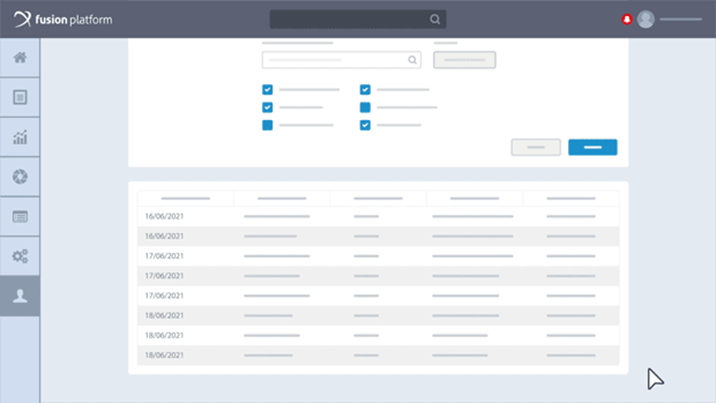
Responsible for storing information on several important topics for a Compliance process, the Fusion Platform audit center has an easy-to-access interface, which makes it possible to find the information you want in a simple and effective way.
In addition, access is only available to users who actually have permission, in order to prevent improper users from accessing sensitive data.
Through this feature, we can check several important data, such as:
- User Access:
Through this option, we obtain information regarding the access of users to the platform. To facilitate the search for information, the function has filter fields, so that it is possible to search by date and specific user, for example.
Having this information in hand, it is much easier to control improper access and outside the allowed hours.
- Registration of Users/Roles/Groups:
By selecting these options, it will be possible to know when a user/role/group has been created, edited, deleted or inactivated in the system, for example. The function also allows us to know who is responsible for the modification, the date, and to carry out filters based on these available fields.
- System settings:
This type of information is extremely important, since, from the moment a general information in the system is modified, all users will be affected.
Therefore, knowing who was responsible and what change was made will help a lot in controlling undue modifications.
- Documents:
Through this selection, we are able to control the publications, edits and deletions of documents in EDM, making errors more easily identified and avoided.
- Process Models:
As much as the edits of the process templates are restricted to module administrators, having control of the changes made will make it possible to prevent incorrect changes from being released for use by users.
- Form Registrations:
Like process templates, changes made to forms are quickly viewed by flow participants. Therefore, knowing which fields have been modified, and who was responsible for the changes, is of great value to administrators.
- Form Records
Through this option, we can access the information filled in the fields of a form and, likewise, the data that has been edited, thus enabling improperly removed data to be recovered.
As we have seen, using the functions available in the Fusion Platform audit center, your Compliance process can be executed in a much safer, easier, and more effective way.
Are you interested in learning about this incredible platform, what numerous benefits can it bring to your organization? Request a demo and enjoy all the features we have to offer.
So, are you ready to improve your organization’s Compliance process? If you have any questions, or have anything to comment on the article, write to us here in the comments.